ROCKWOOLInsulate the building. Protect comfort and use.
Thermal, acoustic comfort and fire behavior: stone wool combines several responses in the same material. With HMA, choose a solution adapted to your structure and its environment.
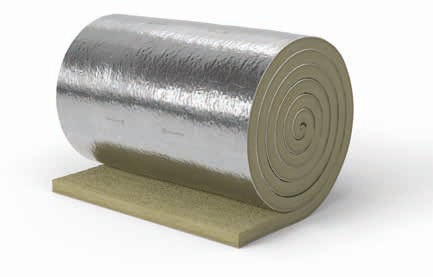
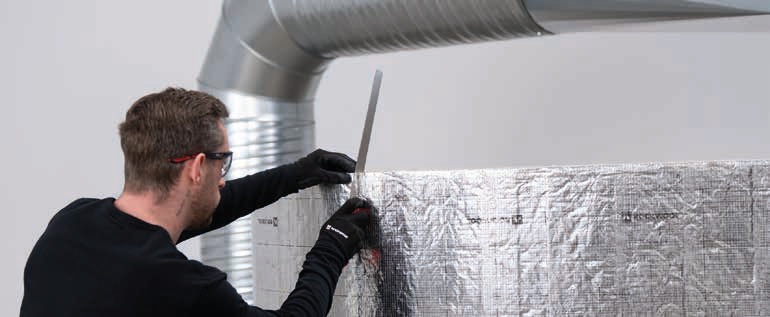
Source: ROCKWOOL · HVAC catalog · aluminum-coated stone wool roll
01 / TECHNICAL & COMPETITIVE BENEFITS
Several requirements. A response to coordinate.
The interest of ROCKWOOL lies in the combination of performances. This is particularly useful when the project must deal with fire, noise and thermal exchanges in the same assembly.
01 / FIRE
Choose non-combustible insulation
Bare ROCKWOOL products, including Rockfaçade, are classified A1 according to EN 13501-1. This characteristic constitutes an argument against the references of combustible insulation when the specifications call for non-combustible insulation.
For your project: integrate a component that does not contribute to the development of fire, in a verified facade or wall design.
Reaction to fire A1 concerns the product. An EI or REI resistance concerns the complete work and requires a classification corresponding to the assembly. Coatings can modify the class. Some glass wools are also A1.
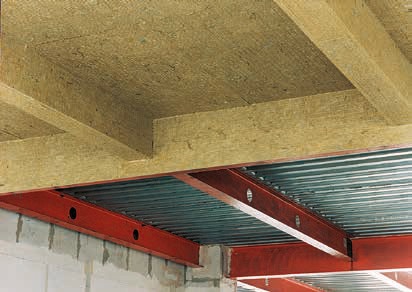
Structural protectionSource: ROCKWOOL · HVAC catalog · p. 15
02 / NOISE
Combine insulation and acoustic comfort
The fibrous structure of stone wool helps absorb part of the sound energy. In a properly designed partition, roof or floor, it contributes to the acoustic treatment of the whole.
For your project: study the comfort of hotel rooms, offices, teaching rooms and healthcare establishments by coordinating insulation, facings and junctions.
The sound absorption of a material and the sound attenuation of a wall are two different data. A gain in decibels cannot be deduced from density alone. Glass wool and other fibrous insulation may also be suitable: compare tested systems.
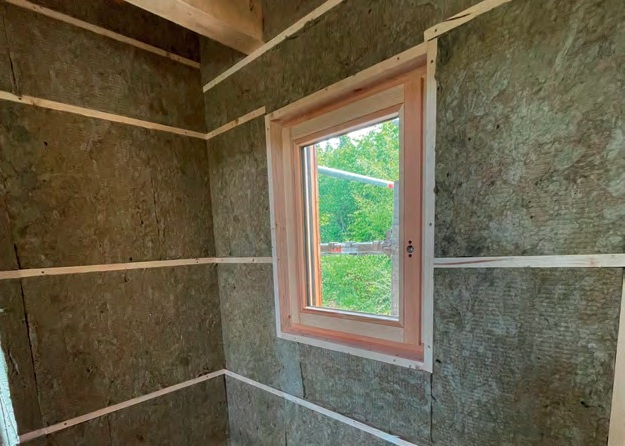
Wall insulationSource: ROCKWOOL · Building Catalog · p. 48
03 / THERMAL
Limit heat exchange
Thermal resistance depends on the conductivity of the product and its thickness. Continuous insulation helps reduce exchanges through the envelope; thermal bridges and airtightness are addressed at the wall level.
For your project: associate a defined level of insulation with the other requirements of the work, with a reference adapted to the application.
Stone wool is not systematically the thinnest insulation with equal resistance. Some PIRs have lower conductivity. Summer comfort and air conditioning needs require a building study.
Roof insulationSource: ROCKWOOL · Building Catalog · p. 23
04 / HUMIDITY
Water and water vapour behaviour — retaining performance
Stone wool panels are open to the diffusion of water vapor. The water resistance and vapor transmission characteristics can be checked on the data sheet for the chosen reference.
For your project: work on vapor transfers in a coherent wall composition, with the necessary membranes and protections.
Insulation does not ensure the waterproofing of the work. Stone wool is not a universal solution for immersion or buried parts. In hot and humid climates with air-conditioned premises, the location of the membranes must result from the hygrothermal study.
For Rockfaçade under ventilated cladding, performance over time is judged on the dimensional stability, the maintenance of the panels and the continuity of the insulation. The product declares DS(70,90) according to EN 1604 and ACERMI certified semi-rigidity.
For your project: have documented elements to study a facade subject to heat and humidity cycles, with suitable fixings, drainage and ventilation.
DS(70,90) designates a test condition of 70°C and 90% relative humidity; this is neither a guaranteed service temperature nor proof of lifespan in a tropical climate. The cladding, joints and fixings determine the durability of the whole.
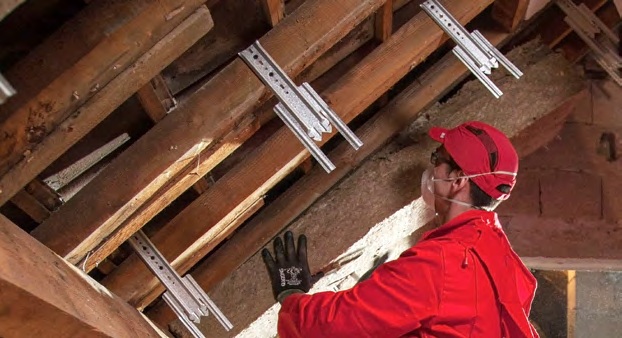
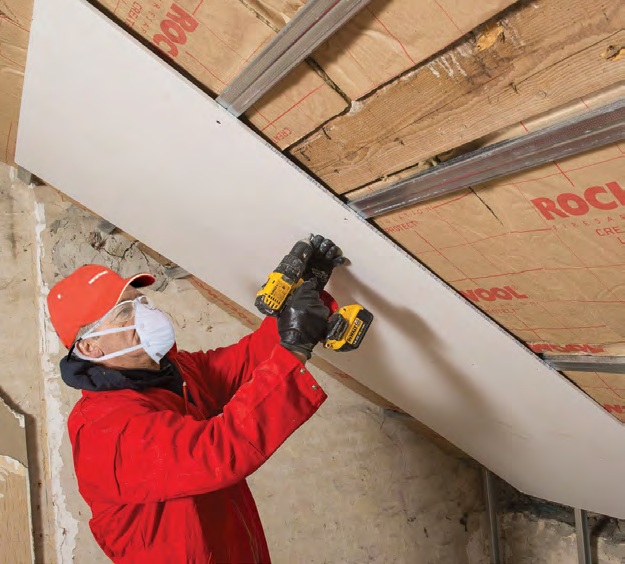
Installation under pitched roofsSource: ROCKWOOL · Building Catalog · p. 26
06 / ENERGY
Study the energy needs of the building
Appropriate insulation helps to limit heat exchange through the walls. Its effect on air conditioning and consumption depends on the entire building: solar protection, glazing, airtightness, ventilation, equipment and uses.
For your project: coordinate insulation with energy studies and compare solutions on common hypotheses, using the appropriate technical sheets and environmental documents.
The presence of an FDES or an EPD does not prove carbon superiority. The environmental comparison concerns the same function, the same duration and a comparable scope. Recycling channels must be checked in the country where the site is located.
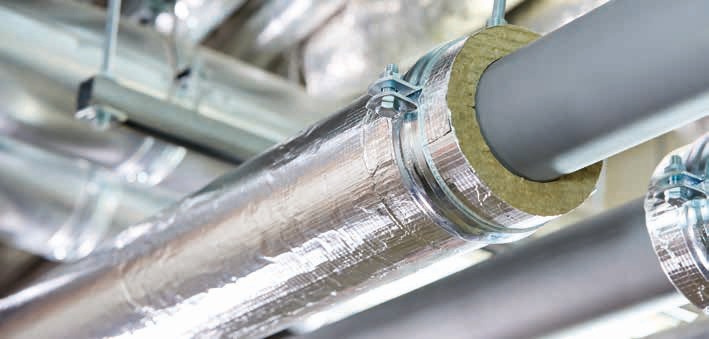
HVAC network insulationSource: ROCKWOOL · HVAC catalog · p. 8
When to include ROCKWOOL in your specification
When you are looking for a solution combining thermal, acoustic and reaction to fire requirements, with technical documentation for the specification. HMA helps you frame the work, select the references to study and organize consultation with project stakeholders.
02 / COMPARISON OF INSULATION FAMILIES
The right material for the right constraints.
No insulation dominates all criteria. Here are the points to compare when choosing ROCKWOOL over other families, without confusing the properties of the material and those of the installed system.
Specification guide · verify products and intended uses
Family
Point of interest
Positioning of ROCKWOOL
Decisive criterion to check
ROCKWOOL stone wool
Combination of thermal, acoustic and non-combustible products.
An option when several performance requirements must be met within one assembly.
Exact product, coating, thickness and system supporting documents.
Glass wool
Thermal and acoustic insulation; Bare references also classified A1.
Fire and acoustics are not enough to decide between two mineral wools. Compare products suitable for use.
Lambda, mechanical behavior, installation and performance of the wall.
PIR · polyisocyanurate
Some products provide significant thermal resistance at low thickness.
ROCKWOOL can be retained when incombustibility and acoustics weigh in the decision, with a thickness to be recalculated.
Lambda, reaction to fire of the product, protection and classification of the assembly.
PUR · polyurethane
Thermal insulation solutions, depending on the formulation and method of implementation.
Compare the thermal, acoustic and fire requirements with a reference ROCKWOOL adapted to the same work.
Declared conductivity, facings, reaction to fire, stability and scope of use of the exact product.
Published examples: GR 32 nu A1, Eurowall F. These rankings concern the products mentioned; they do not characterize all products in their family or complete systems.
03 / HMA COMPARATIVE SCENARIO
Rockfaçade versus alternatives. Six criteria, a project reading.
Editorial rating out of 10 for a facade in a hot and humid climate. The “water and water vapour” and “long-term durability” axes reflect the results and assessments communicated by HMA, without independent comparative validation presented here.
THE CASE ELECTED
Ventilated facade in equatorial or humid tropical climate
Design basis: masonry wall, air-conditioned building, Rockfaçade 140 mm, R declared 4.00 m²·K/W. Exposure in the HMA scenario: relative humidity of around 80%, temperature above 25°C, imperfect protection and risk of condensation.
Duration retained by HMA for this scenario: stone wool approximately 70 years; PIR and PUR 15 to 20 years; glass wool a few weeks to a few months. These durations are the assumptions provided for comparison; they do not constitute universal or guaranteed lifespans of product families.
ROCKWOOL · RockfaçadeGlass woolPIRPUR
Scale from 1 to 10 · the more outward the curve, the more favorable the assessment. HMA positioning notes, without total or certification. Identical values can overlap.
01
Fire
Reaction to fire of the product.
Rockfaçade and Isofaçade 32R: A1. PIR Powerwall: D-s2,d0 on the Belgian sheet cited. PUR: hypothetical class E to be confirmed for the reference chosen. The rating does not represent the EI/REI resistance of the facade.
02
Acoustics
Absorbing potential in the wall.
Editorial grid: 9 for fibrous wools, 5 for rigid foams. Decibel results require tested assembly.
03
Thermal
Comparison at equal thickness.
Notes rounded according to 10 × 0.022 / λ: Rockfaçade 0.035; Isofaçade 32R 0.032; PIR Powerwall 0.022; PUR 0.024 W/(m·K), hypothesis to be confirmed.
04
Water and water vapour
Maintaining performance according to the scenario provided.
HMA scenario ratings: stone wool 10/10, glass wool 1/10, PIR and PUR 3/10. These scores express the requested ranking under hot, humid exposure; they are neither absorption measurements nor quantitative performance ratios.
05
Long-term performance
The durations communicated by HMA.
Editorial conversion by classes: approximately 70 years = 10; 15–20 years = 3; a few weeks to a few months = 1. This scale expresses the scenario provided and does not predict the duration of a project.
06
Energy at equal R-value
The same initial level of insulation.
8/10 for the four solutions with equivalent initial resistance and compliant installation. The note concerns the initial state; it does not quantify consumption or performance retained after aging.
DOCUMENTARY DATA SEPARATE FROM THE SCENARIO
ROCKWOOL: evidence after 65 years in service
ROCKWOOL reports DTI testing in 2023 on insulation sampled from hangar 4 at Copenhagen Airport after 65 years of service, with performance reportedly retained. This in-service evidence supports durability; it does not directly validate the lifetime assumptions or differences in the tropical HMA scenario above.
Insulation benchmark. Eight criteria for demanding projects.
For high-rise buildings and buildings subject to increased requirements, the choice of insulation involves several criteria. This comparison compares stone wool, glass wool, FOAMGLAS cellular glass and PIR/phenolic insulation on eight dimensions: fire behavior, high temperature resistance, mechanical stability in fire, IGH compatibility, thermal and acoustic insulation, compressive resistance and regulatory risk. It helps identify the points to examine to select a solution suitable for the project.
Stone woolGlass woolFOAMGLASPIR / Phenolic
Editorial scale of 1 to 10: a high rating indicates a favorable review. Notes are a conversion added for viewing; the PowerPoint does not contain scores out of 10. The original values and assessments appear below. Source: document provided by HMA, without independent technical validation in this block.
Original benchmark data · slide 1
Criterion
Stone wool
Glass wool
FOAMGLAS
PIR / Phenolic
Reaction to fire
A1 / A2
A1
A1
B to E depending on product
Melting temperature / high temperature resistance
≈ 1000°C
≈ 600–700°C
≈ 1000°C
Degradation 200–300°C
Mechanical resistance in severe fire
Very high
Medium to high
Very high
Low
Suitability for high-rise buildings
Very suitable
Adapted (according to design)
Adapted
Extensive justification required
Lambda (W/mK)
~0,033–0,035
~0,032–0,040
~0,038
0,021–0,024
Acoustic performance
Excellent
Very good
Average
Average
Compression resistance
Good
Average
Very high
Good
Regulatory risk for high-rise buildings
Low
Low to moderate
Low
Medium to high
See ratings out of 10 and conversion method
HMA editorial conversion of document assessments
Criterion
Stone wool
Glass wool
FOAMGLAS
PIR / Phenolic
Reaction to fire
9/10
10/10
10/10
5/10
Melting temperature / high temperature resistance
10/10
7/10
10/10
3/10
Mechanical resistance in severe fire
10/10
8/10
10/10
3/10
Suitability for high-rise buildings
10/10
8/10
8/10
3/10
Lambda (W/mK)
7/10
6/10
6/10
10/10
Acoustic performance
10/10
9/10
6/10
6/10
Compression resistance
8/10
6/10
10/10
8/10
Regulatory risk for high-rise buildings
10/10
8/10
10/10
4/10
Appreciations: very high or excellent = 10; very good = 9; good or average to high = 8; average = 6; low = 3. IGH compatibility: very suitable = 10; adapted, with or without design reservation = 8; heavy justification = 3. Regulatory risk: low = 10; low to moderate = 8; medium to high = 4.
Reaction to fire: A1 = 10; A1/A2 = 9; range B to E = 5 as an editorial representation of the range, without assigning a single class to all products. High temperature: about 1000°C = 10; 600–700°C = 7; degradation at 200–300 °C = 3. These points take up the indications in the document, without assimilating them to a fire resistance classification.
Thermal: calculation 10 × 0.0225 / λ, rounded to the whole number and capped at 10, with the middle of the document ranges: 0.034; 0.036; 0.038; 0.0225 W/(m·K). This is a comparison with equal thickness, distinct from the building's consumption.
The document groups “PIR / Phenolic” into a single series; this category is kept as is. FOAMGLAS is kept in this second comparison. The PUR remains in the first spider. IGH compatibility and regulatory risk depend on the country and the design of the system: these assessments do not constitute regulatory validation of the project. No overall score is calculated.
04 / SOLUTIONS BY WORK
Specify for the assembly, considering every material property.
FACADES
Cladding and envelopes
Insulation behind attached cladding or in a defined facade system. Study the fixings, the air gap, the continuity of the insulation and the fire safety details.
The French references are technical examples. Availability, conformity and conditions of export to the project country must be confirmed before specification.
05 / HMA SUPPORT IN AFRICA
From building requirements to a precise project enquiry.
In Abidjan, Dakar, Casablanca or Kinshasa, priorities differ depending on the building and its environment. HMA prepares with you the criteria to be transmitted to manufacturers, design offices and companies.
Frame
Country, use, climate, orientations, walls and air conditioning mode.
Define
Thermal, acoustic, fire, humidity and mechanical constraints objectives.
Check
Sheets, declarations, system classifications and requirements applicable to the project.
Consult
Surface areas, formats, quantities, availability, logistics and calendar.
YOUR PROJECT WITH ROCKWOOL
Make insulation an informed choice.
Tell us the country, the plans, the surfaces to be insulated and your objectives. Let's build a selection adapted to your operation.
Insulation is chosen for a wall, a roof or equipment. Its thermal conductivity matters, but its behavior in fire, acoustics, water, durability and implementation also count.
ROCKWOOL offers stone wool solutions for different applications. HMA helps you assess their performance and prepare a coherent specification for projects in West, Central and North Africa.
DOCUMENTATION & CREDITS
Data to verify, choices to justify.
Manufacturer sources consulted on October 16, 2026. Values are specific to the references and countries concerned. HMA does not claim any universal superiority or quantified energy savings.
Photographs of the material and its implementation from the ROCKWOOL catalogs provided to HMA: “Building, Façade and Waterproofing Solutions” and “Insulation of HVAC technical installations”. The applications illustrated are not interchangeable: each work requires a suitable reference and system. Brands and visuals: respective owners.
HMA scenario scoring
Editorial ratings out of 10 · water/vapour and duration according to results provided by HMA
Criterion
ROCKWOOL · Rockfaçade
Glass wool
PIR
PUR
FIRE
10/10
10/10
4/10
2/10
ACOUSTICS
9/10
9/10
5/10
5/10
THERMAL
6/10
7/10
10/10
9/10
WATER AND STEAM
10/10
1/10
3/10
3/10
LONG-TERM RESISTANCE
10/10
1/10
3/10
3/10
EQUAL ENERGY
8/10
8/10
8/10
8/10
Origin of the notes: fire and thermal based on the product data and assumptions specified above; acoustics and energy: editorial assessments; water/vapour and duration: results and classification provided by HMA. Competitor products and the exact conditions of HMA observations are not documented on this page. The grid does not replace verification of the system and intended use.